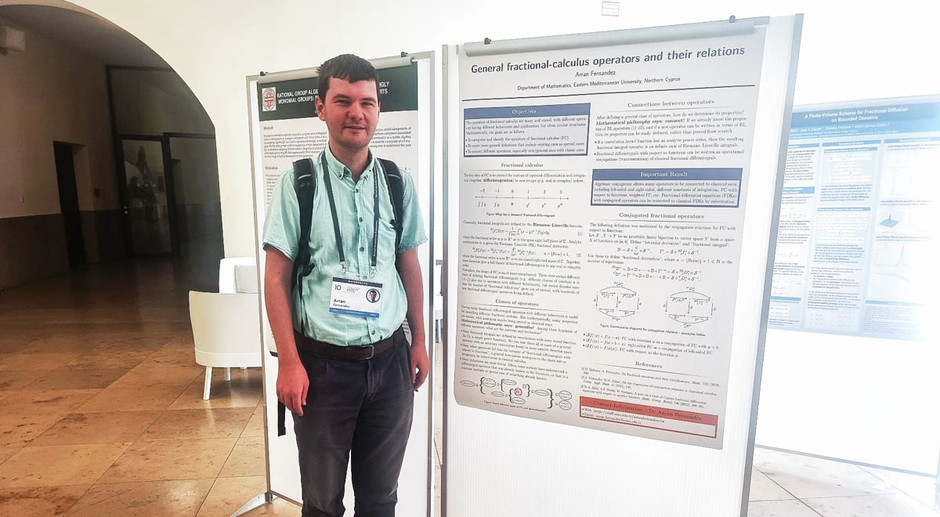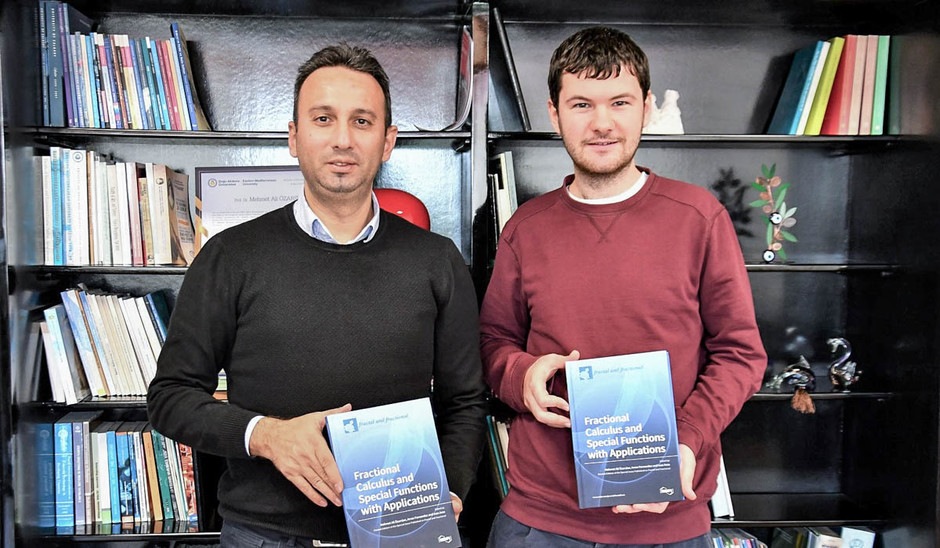


Eastern Mediterranean University (EMU), Faculty of Arts and Sciences, Department of Mathematics academic staff member Assoc. Prof. Dr. Arran Fernandez makes substantial contributions to the university’s international scientific visibility and academic prestige through his service as Associate Editor for several leading scientific journals worldwide. By holding Associate Editor Positions in three distinguished Q1-ranked journals in his field, Assoc. Prof. Dr. Fernandez plays an influential role in some of the foremost scientific publication platforms globally.
Assoc. Prof. Dr. Fernandez’s research interests encompass Fractional Calculus, Special Functions, Asymptotic Methods, and Analytic Number Theory. Since 2025, he has been serving as an Associate Editor for Communications in Nonlinear Science and Numerical Simulation, a journal published by Elsevier and indexed in the Science Citation Index Expanded (SCIE), a sub-index of the Web of Science database. Additionally, he has been an Associate Editor for Evolution Equations and Control Theory, published by the U.S.-based AIMS Press and also indexed in SCIE, since 2024. He likewise contributes as an Associate Editor to Mathematical Methods in the Applied Sciences, published by Wiley.
Moreover, since 2020, Assoc. Prof. Dr. Fernandez has continued to serve as an Associate Editor for Fixed Point Theory for Algorithms in Science and Engineering, a journal published by the distinguished Springer publishing house. This journal is classified as Q3 within the Emerging SCI index and as Q2 in the Scopus database.
“Categories Q1, Q2, Q3 and Q4”
The Q1, Q2, Q3 and Q4 system classifies scientific journals into four equal tiers based on citation metrics—such as the Journal Impact Factor—within their respective subject areas. Q1 denotes the top 25% of journals (the most prestigious), while Q2 represents those in the 25–50% range (upper-middle tier). Q3 covers the 50–75% interval (lower-middle tier), and Q4 includes the bottom 25% (the lowest-ranked group). Generally, prestige and visibility tends to decrease from Q1 to Q4.